



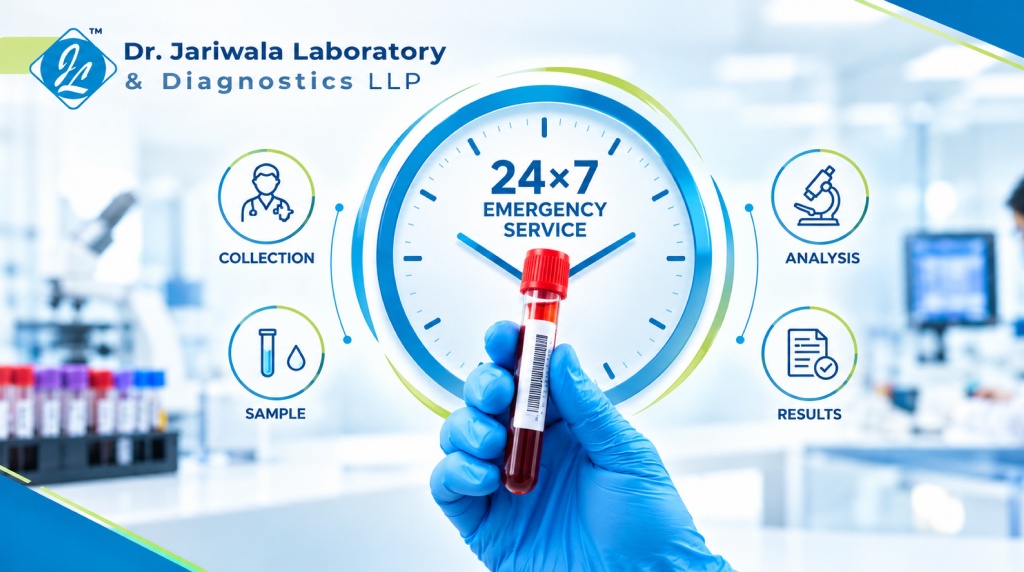
What Happens Behind the Scenes When an Emergency Sample Reaches a Diagnostic Laboratory?
In healthcare, some decisions simply cannot wait until morning.
A patient may arrive at a hospital late at night with severe symptoms. A doctor may need urgent blood investigations to understand what is happening. A critical illness may require laboratory results before the next medical decision can be made.
In such situations, diagnostics become part of the emergency response itself.
Behind a laboratory report that may take only a few minutes to read, there can be a carefully coordinated chain of activities — from identifying the patient and collecting the right sample to transporting, processing, analysing and validating the results.
At Jariwala Laboratory & Diagnostics, emergency diagnostic services are available for urgent diagnostic requirements, subject to an urgent request from a doctor. The laboratory states that its emergency service is available 24 hours, with an emergency charge applicable to such requests.
At its Rokadia Lane centre in Borivali West, Jariwala lists 24×7 sample collection, with emergency hours from 10:00 PM to 7:00 AM Monday to Saturday and 4:00 PM to 7:00 AM on Sundays and holidays.
But what actually happens after an emergency sample reaches a diagnostic laboratory?
Let’s look behind the scenes.
Get started
Book your blood test
We will confirm your home visit shortly.
Why Emergency Diagnostics Matter
When a patient is seriously unwell, doctors often need more than symptoms and physical examination.
Laboratory investigations can provide important information about processes happening inside the body.
Depending on the clinical situation, doctors may request investigations related to:
- Blood cell counts
- Blood glucose
- Kidney function
- Liver function
- Electrolytes
- Infection and inflammation
- Blood clotting
- Cardiac markers
- Urine investigations
- Blood gases
- Other specialised investigations
The specific tests required depend entirely on the patient’s condition and the doctor’s clinical assessment.
Jariwala Laboratory provides a broad range of laboratory investigations, including haematology, biochemistry, immunochemistry, serology, microbiology, clinical pathology, histopathology and cytology. Its listed test menu also includes investigations such as VBG / venous blood gas and other specialised tests.
The important point is that an emergency laboratory is not simply a place where a machine “runs a test quickly.”
There is a process behind every result.
Step 1: The Emergency Request Begins With the Doctor
Emergency testing generally begins with a clinical requirement.
A doctor identifies the investigations that are needed based on the patient’s symptoms, examination and medical situation.
This is particularly important because not every laboratory test needs to be performed immediately.
For Jariwala’s 24-hour emergency service, the laboratory specifically states that emergency samples are collected when accompanied by an urgent request from the doctor.
This helps establish the emergency nature of the request and the investigations that need to be prioritised.
The laboratory team then has an important responsibility:
Make sure the right sample is collected for the right patient and the right investigation.
Step 2: Correct Patient Identification
One of the most important steps in laboratory medicine happens before the sample reaches an analyser.
It is identification.
The patient’s details and requested investigations need to correspond correctly with the sample being collected.
This may appear routine, but it is one of the foundations of laboratory quality.
A diagnostic result is useful only when everyone involved can be confident that:
The result belongs to the correct patient and corresponds to the correct sample.
This is why emergency diagnostics require trained personnel and disciplined procedures, even when every minute matters.
Step 3: Collecting the Right Sample
Different investigations require different types of specimens.
Depending on the test, the laboratory may require:
- Blood
- Urine
- Stool
- Swabs
- Other clinical specimens
Even within blood testing, different investigations can require different collection tubes and sample handling requirements.
The collection process therefore involves more than simply drawing blood.
The sample must be collected appropriately and prepared for the investigation it is intended for.
Jariwala Laboratory provides blood sample collection services and also offers home blood sample collection across Mumbai, Navi Mumbai and Thane. The laboratory also describes facilities for patients who may need blood collection while waiting in their vehicle when a home visit is unavailable, subject to the request being considered genuine.
In an emergency, however, the emphasis is on the urgency of the doctor’s request and the appropriate handling of the specimen.
Step 4: The Sample Enters the Laboratory Workflow
Once the sample reaches the laboratory, the work does not simply begin with pressing a button on a machine.
The specimen needs to enter the laboratory workflow correctly.
This can involve checking details such as:
- Patient identification
- Test requirements
- Sample type
- Sample container
- Sample quantity
- Sample condition
- Appropriate processing requirements
The laboratory must determine whether the sample is suitable for the requested investigation.
For some tests, the condition of the specimen can directly affect the reliability of the result.
This is particularly important in emergency diagnostics because speed must not replace accuracy.
A fast result is valuable only when the underlying sample and testing process are appropriate.
Step 5: Prioritisation of Emergency Investigations
In a normal laboratory workflow, samples may be processed according to established laboratory schedules.
Emergency testing introduces another dimension:
Priority.
When an urgent request is received, the laboratory team has to coordinate the required work so that the investigation can be processed appropriately and the result can move through the reporting process without unnecessary delay.
This is where the human side of laboratory diagnostics becomes important.
Laboratory professionals, technicians and other members of the diagnostic team work together to keep the emergency workflow moving.
The patient may never see this part of the process.
But this is where much of the work happens.
Step 6: Sample Processing and Analysis
The next stage is laboratory analysis.
Depending on the investigation, samples may undergo different preparation and testing procedures.
Modern diagnostic laboratories use specialised analysers and laboratory technologies for many routine investigations.
For example, automated systems can assist with investigations in areas such as:
Haematology
Tests related to blood cells and blood components.
Biochemistry
Investigations that measure substances such as glucose, enzymes, proteins, electrolytes and other biochemical parameters.
Immunochemistry
Tests involving hormones, proteins, antibodies, antigens and other specialised markers.
Microbiology
Investigations related to microorganisms and infectious diseases.
Clinical Pathology
Investigations involving specimens such as urine and other clinical materials.
Jariwala Laboratory lists these and several other disciplines among its diagnostic services.
However, technology is only one part of the process.
Step 7: Machines Generate Results — Professionals Interpret the Process
It is easy to imagine that a diagnostic laboratory simply places a sample inside a machine and receives an answer.
In reality, laboratory diagnostics involve people, processes and technology working together.
Automated analysers can perform sophisticated measurements, but laboratory professionals remain an essential part of the workflow.
They help ensure that samples are processed appropriately, instruments operate according to laboratory procedures and results are reviewed within the applicable laboratory workflow.
Some results may require additional attention or verification before they are released.
This is particularly important when results are significantly abnormal or when there may be a question regarding the sample or analytical process.
The goal is not merely:
“Get the result out quickly.”
The goal is:
“Get the appropriate result out efficiently and reliably.”
Step 8: Quality Checks Matter — Even During an Emergency
Emergency testing does not mean abandoning quality procedures.
Quite the opposite.
When a result may contribute to an urgent medical decision, maintaining laboratory quality becomes especially important.
Laboratories use quality-control processes to monitor analytical performance and help identify problems that could affect results.
The precise quality-control procedures vary according to the laboratory, test and technology being used.
This is why a professional diagnostic laboratory needs more than advanced equipment.
It needs:
- Trained laboratory personnel
- Appropriate equipment
- Proper sample handling
- Quality-control procedures
- Established laboratory processes
- Documentation
- Timely communication
These principles are also part of the broader diagnostic philosophy described by Jariwala Laboratory in its 45-year journey.
Step 9: Reviewing and Validating the Result
Once the analytical process is complete, the journey may still not be over.
The result needs to move through the laboratory’s reporting workflow.
Depending on the investigation and circumstances, laboratory professionals may review the result and associated information before it is released.
This is particularly important when a result is unusual, unexpected or potentially significant.
A laboratory report is therefore not simply a collection of numbers.
It is the final output of a chain that begins with:
Patient → Doctor → Sample → Laboratory → Analysis → Review → Report
Every link matters.
Step 10: The Result Reaches the Doctor
Ultimately, the purpose of emergency diagnostics is to provide useful information to the treating medical team.
A laboratory does not independently diagnose the patient based on a single test result.
The doctor interprets laboratory findings alongside:
- Patient symptoms
- Medical history
- Physical examination
- Imaging
- Previous results
- Other investigations
- Clinical circumstances
The laboratory’s role is to provide reliable diagnostic information that can support the healthcare team.
That distinction is important.
A laboratory result is one part of the clinical picture — not the entire picture.
What Happens If a Test Is Not Performed In-House?
Not every diagnostic laboratory performs every possible investigation within its own facility.
Jariwala Laboratory states that when a particular test is not performed by the laboratory, it can arrange for the specimen to be forwarded to a referral laboratory for analysis.
This is another example of why emergency diagnostics require coordination.
The question is not always simply:
“Can this laboratory perform the test?”
It may also involve:
- What test has been requested?
- What specimen is required?
- Where can the investigation be performed?
- How should the specimen be handled?
- How urgently is the result required?
For specialised investigations, appropriate referral and specimen handling become important parts of the diagnostic pathway.
What Makes Emergency Laboratory Work Different?
The biggest difference is not necessarily the test itself.
It is the time sensitivity.
A routine diagnostic sample and an emergency diagnostic sample may pass through many of the same fundamental laboratory principles.
But in an emergency, the clock matters.
The team may have to coordinate:
Urgent request → Sample collection → Identification → Processing → Analysis → Review → Reporting
with minimal unnecessary delay.
At the same time, accuracy cannot simply be sacrificed for speed.
This creates a fundamental principle of emergency diagnostics:
Speed matters. Accuracy matters. Both matter together.
The People You Don’t See Behind an Emergency Report
When a patient receives a laboratory report, they may see only a few pages or a digital report on a screen.
What they may not see are the people involved in getting that report there.
Depending on the circumstances, the diagnostic journey can involve:
- The treating doctor
- Reception and registration staff
- Phlebotomists
- Laboratory technicians
- Laboratory professionals
- Quality-control personnel
- Reporting staff
- Administrative and support teams
- Referral laboratories, when required
Every person has a role.
Jariwala Laboratory’s own 45-year history describes diagnostic care as involving experienced medical professionals, skilled technicians, careful sample collection, sample handling, quality control, technology, timely reporting and attention to detail.
That is the part of laboratory medicine patients rarely get to see.
Why 24×7 Availability Matters
Illness does not follow office hours.
A medical emergency can happen at:
- 11:30 PM
- 2:00 AM
- 5:00 AM
- Sunday afternoon
- A public holiday
That is why access to emergency diagnostic services can become important when healthcare cannot wait for the next working day.
Jariwala Laboratory lists 24-hour emergency service for urgent diagnostic requirements, subject to a doctor’s request.
The Rokadia Lane centre in Borivali West specifically lists 24×7 sample collection, with dedicated overnight emergency hours.
This does not mean that every test or every service is necessarily available at every centre at every hour. Different investigations and facilities may have specific requirements, appointments or locations.
Patients should therefore contact the laboratory and confirm the appropriate emergency service before visiting.
Emergency Diagnostics Is About More Than Machines
Modern laboratory medicine has benefited enormously from automation and technology.
But emergency diagnostics are not simply about having sophisticated analysers.
They depend on the entire system working together.
A sample can only produce a meaningful result when:
The right patient has the right sample, collected correctly, handled appropriately, analysed properly and reported through an established process.
That is why laboratory medicine is both a science and a system of carefully coordinated processes.
Jariwala Laboratory: Supporting Patients When Time Matters
For more than four decades, Jariwala Laboratory has been part of the diagnostic healthcare landscape of Western Mumbai.
Established in 1981, the laboratory has grown into a diagnostic network serving communities across Borivali, Kandivali and Dahisar. Its current services include laboratory investigations, home blood sample collection, paediatric blood collection, X-ray and ECG at designated centres, 2D Echo, Colour Doppler, ultrasound and emergency diagnostic services.
Emergency diagnostics represents a particularly important responsibility.
When a doctor requests an urgent investigation, the sample is not simply another tube waiting in a queue.
It represents a patient who may be waiting for an answer.
And behind that answer is a team working through a process designed to move from sample to result as efficiently and responsibly as possible.
A Report May Look Simple. The Journey Behind It Isn’t.
The next time you receive a diagnostic report, remember that the numbers on the page are only the visible end of a much longer journey.
Behind the report may be:
A doctor’s request.
A carefully collected sample.
Correct identification.
Laboratory processing.
Advanced analytical technology.
Quality checks.
Professional review.
And a team working to make the result available when it is needed.
In an emergency, those steps become even more important because time becomes part of the equation.
At Jariwala Laboratory, the commitment to emergency diagnostics is part of a broader philosophy of making diagnostic healthcare accessible to the communities it serves.
Because when healthcare can’t wait, diagnostics shouldn’t have to wait either.
Emergency Diagnostic Services at Jariwala Laboratory
Jariwala Laboratory provides 24-hour emergency diagnostic services for urgent requirements, subject to an urgent request from a doctor. An emergency charge of 20% is applicable according to the laboratory’s published service information.
The Rokadia Lane centre, Borivali West, lists:
- 24×7 sample collection
- Emergency hours: 10:00 PM–7:00 AM, Monday–Saturday
- Emergency hours: 4:00 PM–7:00 AM, Sundays & holidays
Patients requiring emergency diagnostic services should contact Jariwala Laboratory in advance to confirm the appropriate service, investigation and centre.
Contact Jariwala Laboratory
Customer Care: 022-62322400
Alternate: +91 8062816767
Email: feedback@jariwalalab.com
Jariwala Laboratory & Diagnostics LLP
1st Floor, Rasraj Heights, Above Corporation Bank, Rokadia Lane,
Borivali West, Mumbai – 400092.
Important Note
Emergency diagnostic services are intended for urgent medical requirements and are provided according to the laboratory’s stated emergency-service conditions. Laboratory testing does not replace emergency medical care. If a patient is experiencing a serious or life-threatening medical emergency, immediate medical attention at an appropriate emergency healthcare facility should be sought.